6 min read
The general rule
Texas follows the common-law rule most states follow. A tree belongs to whoever owns the land its trunk stands on. That is the test. Not where the roots run, not where the canopy reaches, not who planted it. Where the trunk sits.
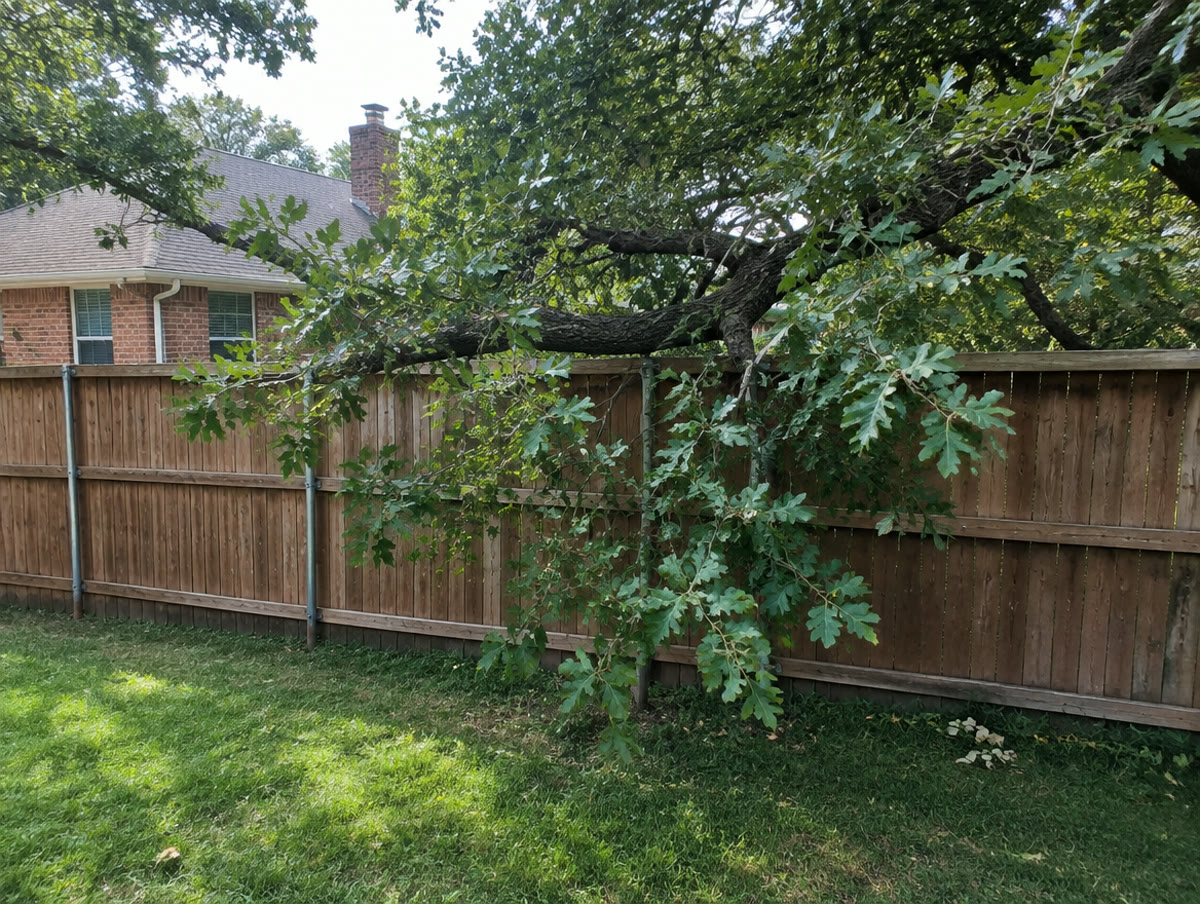
If the trunk is on your neighbour's side, the tree is theirs. But the branches that cross over your property line are a nuisance you are allowed to abate yourself. In plain terms, you can cut what hangs over your side.
The four limits that catch people out
1. You can only cut to the property line
Not one inch past it. Reaching over the fence to make a cut flush against their trunk is trespass, and the cut itself may be damage to their property. Cut on your side of the vertical plane and stop.
2. You pay for it
Your neighbour is under no obligation to pay for trimming you chose to do for your own benefit. If you want the branches gone because they drop leaves in your pool, that is your bill.
3. You cannot kill the tree
This is the one that ends up in court.
Trim hard enough that the tree dies, or becomes unsafe, and you can be liable for what it was worth. A mature shade tree is appraised higher than most people expect.
There is a safety side too. Take one whole side off a tree and it can start leaning wrong in the wind. Now the problem is on your land.
4. It changes when the tree is already dangerous
The rules above assume a healthy tree. Where the tree is visibly dead, diseased, or obviously unstable, and the owner has been told about it, the balance shifts. An owner who knows their tree is a hazard and does nothing can be liable for the damage it causes when it comes down. Which is why the next section matters more than the trimming rules do.
Put it in writing first
Before anyone touches anything, tell your neighbour, in writing, that you are concerned. Text or email is fine. A dated message that says the large limb over my garage looks dead and I am worried about it does two things. It usually gets the problem solved neighbourly. And if it does not, it establishes that the owner knew.
Photograph the tree. Date the photos. If a limb later comes through your roof, the difference between a claim that settles and a claim that drags is usually whether anybody can show the owner was told.
What about roots?
Roots follow broadly the same rule as branches. You may cut roots that cross onto your land, and the same limit applies: not so much that you kill or destabilise the tree. Be careful here, because roots are structural. Trenching a foundation line and severing major roots on one side is a common way to make a healthy tree fall in the next storm.
Fruit and fallen leaves
Fruit on an overhanging branch belongs to the tree's owner, even while it is hanging over your side. Leaves, seed pods and small deadfall are treated as a natural nuisance nobody is liable for. You will not win a claim over having to rake.
The honest practical advice
Almost all of these are cheaper to solve with a conversation than with a lawyer. Most neighbours say yes when you ask first. Very few say yes after the fact.
If the tree really is a hazard, get someone to look at it. Put your concern in writing. Deal with it before the next storm decides for both of you.
This is general information, not legal advice. Property law turns on the facts of your case. Wichita Falls may add rules of its own, especially near power lines, sidewalks and public paths. Talk to a Texas attorney before you act on anything with money on it.